
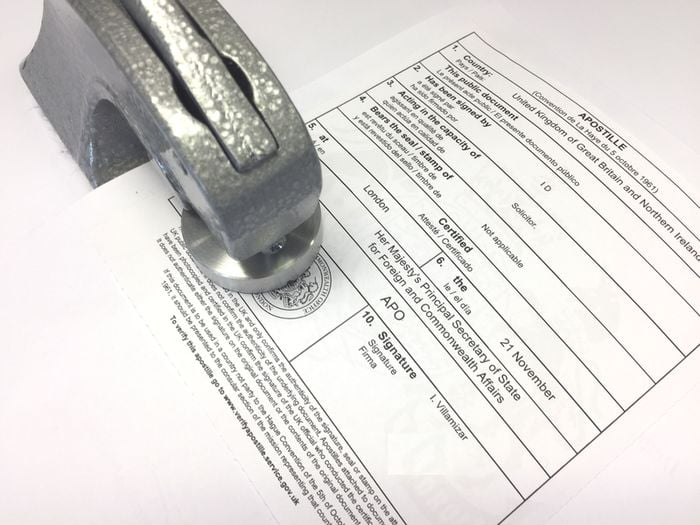
When traveling or moving abroad, you might need to present various official documents, such as birth certificates, marriage licenses, diplomas, or power of attorney letters. However, these documents may not be recognized in foreign countries without proper validation. The apostille certification process is a way to authenticate these documents for international use. By providing a standardized form of verification, an apostille ensures that your documents are legally valid in countries that are part of the Hague Convention.
What Is an Apostille?
An apostille is a certification issued by an authorized government agency that authenticates the origin of a public document. The apostille verifies that the document is genuine and issued by a competent authority. This process is based on the 1961 Hague Convention Abolishing the Requirement of Legalization for Foreign Public Documents, a treaty signed by over 120 countries. The apostille itself is a stamped certificate that is attached to the original document.
Unlike traditional legalization, which often involves a lengthy and complex procedure through consulates and embassies, the apostille offers a simplified and standardized method for document authentication. This makes it easier and faster for individuals and businesses to use their documents internationally.
The apostille cfg Certification Process
-
Determine the Requirement: The first step is to determine whether you need an apostille for your document. Generally, apostilles are required for documents that will be used in countries that are part of the Hague Convention. However, non-member countries may require different procedures, so it’s essential to verify the rules for the specific destination country.
-
Prepare the Document: Next, ensure that the document is an original or a certified copy issued by a government authority. Common documents that require an apostille include birth certificates, marriage certificates, divorce decrees, academic transcripts, and powers of attorney. If your document is not in the required format, it may need to be notarized or certified by the issuing agency before proceeding with the apostille process.
-
Submit the Document to the Competent Authority: In most countries, the office responsible for issuing apostilles is typically the Secretary of State, Ministry of Foreign Affairs, or another designated government entity. You will need to submit your document to this office along with any necessary forms, fees, and identification.
-
Authentication Process: Once submitted, the competent authority will verify the authenticity of the document by checking the signatures, seals, and stamps. They will then issue the apostille, which is either attached to the document itself or provided as a separate certificate.
-
Receiving the Apostilled Document: After processing, you will receive the apostilled document, which can now be used in any country that recognizes the Hague Convention. Depending on the processing office, the apostille may be delivered in person, by mail, or through an online system.
Key Benefits of Apostille Certification
-
Global Recognition: Apostilled documents are widely accepted in over 120 countries, ensuring that your paperwork is valid for international use without requiring additional verification.
-
Simplified Process: The apostille eliminates the need for consular legalization, streamlining the authentication process and reducing wait times.
-
Cost-Effective: Compared to traditional legalization methods, obtaining an apostille is often more affordable.
Conclusion
The apostille certification process is essential for ensuring that your documents are valid and legally recognized abroad. Whether you are moving to a new country, conducting international business, or planning to marry overseas, understanding and obtaining an apostille can save time and effort, making the entire process smoother. By following the correct procedures and ensuring that you have all the required documentation, you can rest assured that your documents will be accepted and recognized globally.